

- Mount Fuji – the most sacred symbol of good fortune
- Kumade – the rake that gathers wealth and fortune
- Maneki-neko – the waving cat that beckons good luck
- Carp flag – a lucky charm for baby boys
- Hina doll – a doll that brings peace to little girls
- Sarubobo – the “baby monkey” praying for a safe delivery for both mother and child
- Akabeko – the red cow from Fukushima
- Fox – messenger of the god Inari
- Daruma – the roly-poly toy that makes dreams come true
Mount Fuji – the most sacred symbol of good fortune

Imabari scarf set featuring Mount Fuji
Price: 3,300 yen
Mount Fuji has long been a sacred and powerful symbol in the Japanese psyche.
With its graceful, elongated shape from summit to base, widening at both ends, Mount Fuji symbolizes a bright future and lasting prosperity. In Japanese, “Fuji” is pronounced “fuji,” which is a homonym for “immortality,” thus Mount Fuji is also considered a symbol of good fortune, a wish for a long and healthy life.
You can easily find countless souvenirs featuring Mount Fuji. And of course, don’t forget to capture moments beside this legendary mountain to fully experience the positive energy of your visit to Japan!
Kumade – the rake that gathers wealth and fortune

Buy at Amazon (30cm)
Buy at Rakuten (50cm)
Price: 2,980 yen ~
Kumade is a brightly colored, rake-shaped ornament adorned with various lucky charms.
It is believed to symbolize “gathering good fortune” or “raking in wealth,” making it a symbol of prosperity and successful business. At the end of the year, during the Tori no Ichi festivals held throughout Japan, Kumade is widely sold in the hope of bringing good luck and success in the new year.
If you want to attract good fortune and increase your income, consider placing a Kumade in your home!
Maneki-neko – the waving cat that beckons good luck

Coin purse with Maneki-neko design
Price: 1,320 yen
Maneki-neko is a quintessential Japanese lucky charm believed to bring good fortune and prosperity in business. A cat raising its right paw brings money, while a cat raising its left paw brings customers.
Maneki-neko comes in many different colors, each with its own meaning. Yellow is favored for financial luck, while green is believed to bring health.
And if you’re seeking love, choose a pink cat!
Carp flag – a lucky charm for baby boys

Price: 3,784 yen ~
Carp flags are a traditional Japanese decoration. They are displayed on Children’s Day, May 5th, with the hope of wishing healthy growth for young boys.
Legend says that carp swimming against the current of a waterfall will transform into dragons, so carp flags are also considered a symbol of success and advancement.
Typically, a set of carp chess pieces includes a black carp (representing the father), a red carp (representing the mother), and a blue carp (representing the child).
Carp flag is a perfect choice for families with a baby boy, but anyone who loves Japanese culture can decorate with it.
Hina doll – a doll that brings peace to little girls

Glass Hina doll
Price: 4,510 yen ~
Hina dolls are Japanese dolls that symbolize the wishes for growth and happiness of young girls. They are displayed annually on March 3rd, during the Hinamatsuri festival for girls.
A traditional Hina doll set usually has multiple tiers and many dolls, but it is quite expensive. Instead, you can choose a simpler Hina doll set consisting of a king and queen, which is both affordable and compact, suitable for display in smaller spaces.
Hina dolls are not only meaningful decorative items for families with little girls, but they can also become a charming focal point in your home.
Sarubobo – the “baby monkey” praying for a safe delivery for both mother and child

Set of 2 Sarubobo keychains
Price: 3,888 yen ~
Sarubobo is a characteristic souvenir of Gifu Prefecture and also a popular amulet. The name “Sarubobo” means “baby monkey,” and it is considered a lucky charm that wards off bad luck, promotes family harmony, and ensures safe childbirth.
Sarubobo comes in various colors, with red being the most common. A distinctive feature of Sarubobo is its faceless design, allowing the owner to freely imagine Sarubobo’s expression according to their mood.
With its adorable appearance, Sarubobo makes a meaningful gift for children or pregnant women.
Akabeko – the red cow from Fukushima
Price: 2,420 yen ~
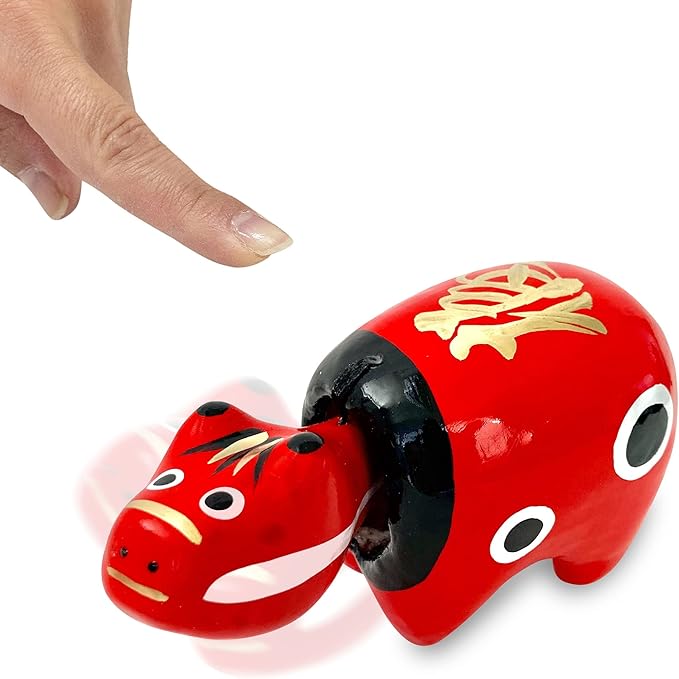
Akabeko is a popular folk toy from Fukushima Prefecture. Made from papier-mâché, it’s shaped like an adorable red cow.
The Japanese believe that red symbolizes good luck, so Akabeko is considered a talisman to ward off evil spirits and bring peace. With its amusingly bobbing neck, Akabeko is also a popular souvenir.
You can place Akabeko in a room to attract good luck or give it to a family with young children as a wish for peace and safety for the baby.
Fox – messenger of the god Inari
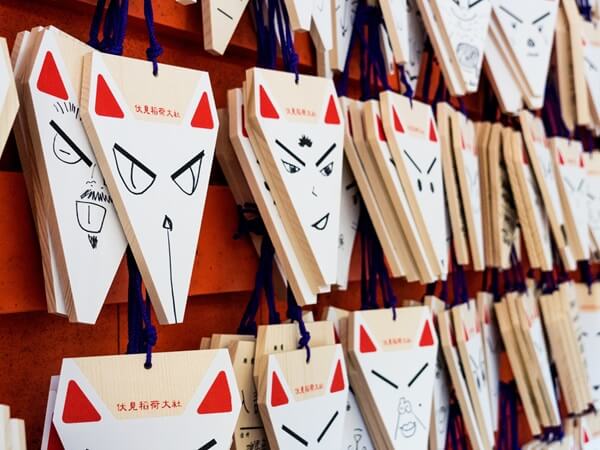
In Japan, foxes are considered messengers of the god Inari. Therefore, since ancient times, foxes have been cherished as lucky mascots that bring bountiful harvests, prosperity in business, and peace in the family.
Many fox-themed items are sold in Japan. My suggestion is the fox-shaped Ema wooden plaques sold at Inari shrines. You can write your wish on the back of the plaque, hoping the fox will convey your prayer to the gods.
Daruma – the roly-poly toy that makes dreams come true

Set of 7 colorful Daruma dolls
Price: 3,500 yen
Daruma dolls are a quintessential Japanese lucky charm.
With their unique design, Daruma dolls always stand up on their own, even if pushed over. Therefore, Daruma symbolizes perseverance and never giving up in the face of failure.
Another interesting characteristic of Daruma dolls is that they don’t come with eyes initially; after purchasing one, you draw eyes on it yourself.
Make a wish and draw one eye (usually the left eye), and when your wish comes true, draw the other eye.
This is a special gift suitable for those who love Japanese culture or like to collect small and beautiful things.



Comment